TRUE REST FLOAT SPA
Aquahenosis: The Altered State Scientists Found Inside a Sensory Deprivation Tank
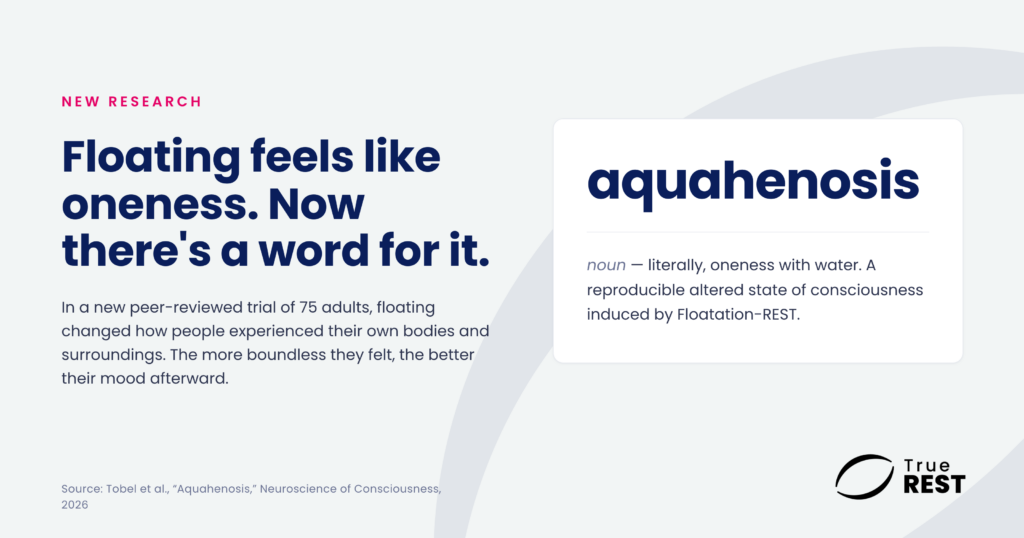
A sensory deprivation tank doesn’t add anything to the experience. It takes things away: light, sound, gravity, the usual background noise of being a body in a room. For 70 years, researchers have tried to describe what fills that gap once it opens up. A 2026 study out of the Laureate Institute for Brain Research and the University of Tulsa finally gave it a name: aquahenosis, a drug-free altered state of consciousness that showed up reliably inside the tank, and only there.
What Is Aquahenosis, and Why Does a Sensory Deprivation Tank Cause It?
Aquahenosis is the term a research team led by Theo Tobel, with senior authors Nicco Reggente and Sahib Khalsa, used to describe a specific pattern that emerged from floatation-REST sessions in their study, published in the peer-reviewed journal Neuroscience of Consciousness. The word combines “aqua” with “henosis,” a term for a felt sense of oneness, and it describes exactly what participants reported: Oceanic Boundlessness, Disembodiment, and an Experience of Unity, measured using a standard altered-states rating scale. The cause wasn’t a substance. It was the tank itself: neutral buoyancy, skin-temperature water, and almost nothing left for the senses to track.
Inside the Study: 75 People, One Sensory Deprivation Tank, Three Groups
The study was a secondary analysis of a randomized controlled feasibility trial. Seventy-five treatment-seeking adults with anxiety and depression were split three ways: one group floated six times on a fixed weekly schedule, a second group floated six times but chose their own session length and spacing, and a third group simply reclined in a zero-gravity chair as a comparison condition with no tank at all. Every group got real attention and real time off their feet. Only one group had their senses actually reduced.
What the Sensory Deprivation Tank Produced That the Chair Didn’t
Compared to the chair condition, time in the tank was associated with measurably increased interoceptive awareness, meaning participants became more attuned to their own cardiorespiratory sensations, heartbeat and breath, instead of the outside world. Alongside that came the altered state the researchers named aquahenosis. Notably, the effect was strongest in the group that chose their own float length and timing rather than following a fixed schedule, suggesting the state deepens the more a person settles into a session rather than clock-watching through it. The researchers also found that the experiential profile selectively overlapped with profiles reported after psilocybin and ketamine, specifically along the boundary-dissolution dimensions, the sense of the usual edges between self and surroundings softening.
Why This Doesn’t Require a Substance, Just an Hour
This is the detail worth sitting with: nobody in the float group took anything. The altered state came entirely from subtraction, not addition. That lines up with something we’ve written about before: a float session removes the inputs the nervous system spends all day reacting to, and once there’s nothing left to respond to, the body and mind shift on their own. Aquahenosis looks like the deeper end of that same mechanism, not a separate phenomenon. It’s also a reminder that the sensory deprivation tank’s history has always had this duality built in. The same tank Dr. John C. Lilly used to study the far edges of consciousness in the 1950s and 60s is the one clinical researchers are now using to treat anxiety and depression. We unpacked the full naming history, sensory deprivation versus flotation therapy versus REST, in an earlier post if you want the longer version of how one tank ended up with several names and several reputations.
What This Means If You’re Considering a Sensory Deprivation Tank
This study was done in a clinical population, treatment-seeking adults with anxiety and depression, using a research-grade protocol, so it isn’t a claim that every float produces aquahenosis or that floating replaces clinical care. What it does establish is that a sensory deprivation tank can reliably produce effects researchers previously associated almost exclusively with psychedelic compounds, without the compound. For anyone who has wondered what actually happens once the lights go off and the water goes quiet, this is the most direct scientific answer so far: something measurable, something real, and something available without a prescription. You can find a True REST location near you and book an hour to find out what that subtraction feels like for yourself.
Source: Tobel, T., Cone, A., Choquette, E., Garland, M., Johnson, M. A., Mink, K., Lynch, C., Frohlich, J., Feinstein, J. S., Reggente, N., & Khalsa, S. (2026). Aquahenosis: a non-pharmacological altered state of consciousness induced by floatation-REST in individuals with anxiety and depression. Neuroscience of Consciousness, 2026(1), niag044.