TRUE REST FLOAT SPA
The History of the Sensory Deprivation Tank: From Cold War Lab to Modern Mental Health Tool
Search “sensory deprivation tank” and you’ll find two very different stories. One is a fringe 1950s experiment involving a Cold War-era neuroscientist, dolphins, and a psychedelic film that scared a generation. The other is a mainstream wellness protocol backed by clinical research, used by nurses, veterans, athletes, and anxious first-timers who just want an hour where their brain finally stops. Both stories are true. Understanding how one sensory deprivation tank story became the other says a lot about why float therapy exists today, and why it’s needed more now than ever.

1954: A Neuroscientist Builds the First Sensory Deprivation Tank
The sensory deprivation tank was developed in 1954 by John C. Lilly, a physician and neuropsychiatrist training in psychoanalysis at the National Institute of Mental Health. The prevailing theory at the time held that the brain’s energy came entirely from external stimulation, and that if you removed all sensory input, the brain would essentially shut down and go to sleep. Lilly wanted to test that theory directly.
He built his first sensory deprivation tank using borrowed equipment originally meant to test the metabolism of swimmers: total submersion in body-temperature water, in total darkness and silence, with a mask supplying air. Early subjects floated upright, wearing an oxygen mask that blocked out light entirely. It looked nothing like a spa. It looked like a research apparatus, because that’s exactly what it was.
What Lilly found upended the sleep theory. Instead of shutting down, the brain stayed active. Awareness didn’t disappear when the outside world did. It simply had nothing left to respond to. Modern research on the parasympathetic nervous system now explains exactly why: reduced input shifts the body into rest-and-repair mode rather than shutdown.
The 1960s and 70s: Consciousness Exploration Meets Counterculture
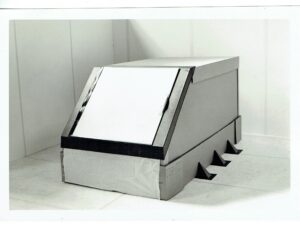
Lilly kept refining the sensory deprivation tank design through the late 1960s, eventually replacing the mask and full submersion setup with a simpler approach: a shallow tank saturated with Epsom salt, dense enough that the body floats on the surface on its own. That’s the basic design float therapy still uses today.
But the era shaped how the tank got understood. Lilly’s own writing, including his 1972 book “The Center of the Cyclone” and 1977’s “The Deep Self,” described the tank as a gateway to inner space, and he combined his own float sessions with psychedelics as part of his personal research into consciousness. The counterculture movement of the 1970s embraced the sensory deprivation tank as a tool for altered states, not relaxation. That association, tank plus mind-altering substance, is where the modern stigma starts.
1972 to 1979: From Research Apparatus to Public Storefront
The sensory deprivation tank didn’t stay in the lab. In 1972, computer programmer Glenn Perry attended one of Lilly’s workshops and began selling the first commercial float tanks under the name Samadhi. By 1979, the first public float center had opened in Beverly Hills, California, running five tanks. For a moment, floating looked like it might go mainstream on its own momentum.
1980: One Movie Sets the Sensory Deprivation Tank’s Reputation for 20 Years
Then came “Altered States,” a 1980 film loosely inspired by Lilly’s work, in which a psychopathologist combines a tank with hallucinogens and starts physically devolving. It was science fiction, not science. But it was the public’s first real exposure to the isolation tank, and it did more to define “sensory deprivation” in the popular imagination than a decade of actual research had. The tank became a horror-adjacent curiosity: something a little dangerous, a little fringe, definitely not something you’d casually book on a Tuesday.
The industry took a second hit later in the decade for a much more mundane reason. As HIV and AIDS fears spread through the 1980s, the idea of floating in shared water put people off regardless of how the water was actually treated, and center after center closed.
The Quiet Decades: Research Kept Going Even When the Public Wasn’t Watching
Through the 1980s and 90s, while public interest in the sensory deprivation tank cooled, researchers didn’t stop. Studies on floating’s effects on blood pressure, athletic recovery, and stress physiology continued at universities, and by the 1990s and 2000s that body of academic work, including research out of Karlstad University in Sweden and the Laureate Institute for Brain Research in the U.S., started building a real clinical case for what Lilly had stumbled onto decades earlier: reduced external input gives the nervous system room to recover in ways it rarely gets otherwise.
The industry also gave itself a new name during this stretch, floatation REST (Reduced Environmental Stimulation Therapy), precisely to put daylight between the clinical reality and the “isolation tank” baggage the 1980s had left behind.
2010: True REST Is Founded, and the Sensory Deprivation Tank Becomes Maintenance Instead of an Experiment
By the time True REST opened its first location in Scottsdale in 2010, floating had the research base to stand on its own. What it needed was an experience that looked and felt nothing like a converted lab apparatus, and a framing that had nothing to do with 1970s consciousness experiments or 1980s horror films. True REST became the pioneer of floatation therapy in America, built around exactly that: private, modern, clean pods, skin-temperature water, 1,000 pounds of Epsom salt, and a straightforward premise. An hour where the world goes quiet and the nervous system gets to actually rest. You can find a location and book a session on our locations page.
Why the Old Sensory Deprivation Tank Stigma Matters Now, Not Just as Trivia
Here’s the part worth sitting with. The thing that made sensory deprivation sound frightening in 1980, the idea of cutting off all outside input, is the exact thing people are now actively seeking out. The average person’s daily sensory load (notifications, screens, noise, decisions) has gone up enormously since Lilly’s era. The tank didn’t change. The amount of stimulation everyone is trying to get a break from did.
That’s also why floating doesn’t fit neatly into the current wave of biohacking and longevity stacking, and shouldn’t be marketed like it does. Most of that conversation is about adding another input: another supplement, another device, another protocol layered onto an already-overloaded system. Float therapy works in the opposite direction. It’s the one hour that removes input instead of adding it, which is exactly what a nervous system that’s never allowed to settle actually needs.
It’s also why real testimony matters more than a features list here. The people who’ve floated through panic attacks, chronic pain flares, grief, and burnout aren’t describing a spa treatment. They’re describing the first hour in a long time where nothing was asking anything of them. That’s a very different story than the one “sensory deprivation tank” used to tell, and it’s the truer one.
The sensory deprivation tank hasn’t changed much since Lilly’s later designs. What changed is that the world finally caught up to why he built it in the first place.